Smoke and Mirrors on the Order Book: What Exchange Volume Numbers Are Actually Hiding
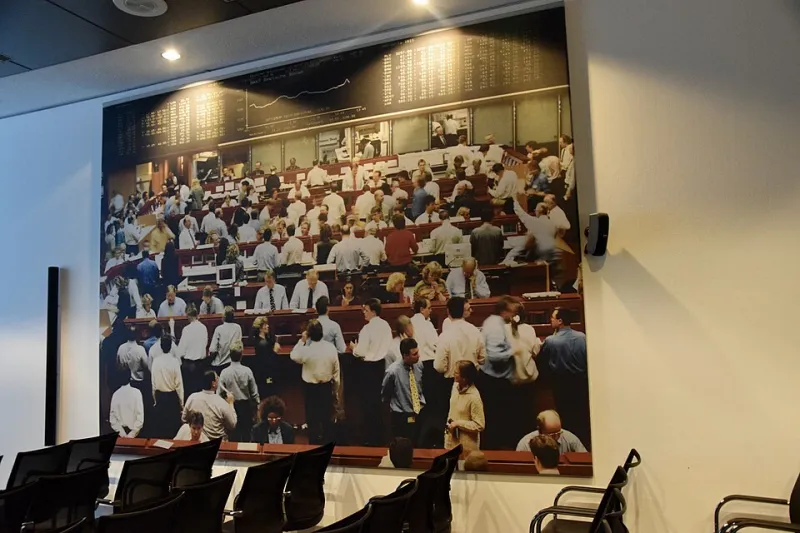
Photo: Ank Kumar, CC BY-SA 4.0, via Wikimedia Commons
There's a number on every exchange dashboard that looks authoritative. It's big, it refreshes every few seconds, and it comes with a little green or red arrow to make you feel like something real is happening. That number is daily trading volume. And in a lot of cases, it's a polished fiction.
This isn't a fringe accusation. It's been documented, studied, and quietly acknowledged by people inside the industry for the better part of a decade. What's less talked about is why it keeps happening — and more importantly, how the traders operating in the deeper layers of crypto markets have been exploiting these distortions to find actual liquidity while everyone else gets burned chasing phantom depth.
The Inflation Game and Who Benefits
Wash trading — the practice of simultaneously buying and selling the same asset to generate artificial volume — is the oldest trick in the exchange playbook. On traditional markets, it's explicitly illegal. In crypto, enforcement has been spotty at best, and the incentives to inflate numbers are enormous.
Exchanges compete for listings. Projects pay to be listed, and they pay more to be listed on platforms with higher reported volume. Higher reported volume also attracts retail traders who assume activity equals legitimacy. It's a feedback loop that rewards dishonesty.
Research firm Bitwise put a number on this back in 2019, estimating that roughly 95% of reported Bitcoin trading volume on unregulated exchanges was fake. The SEC cited that report when it was rejecting Bitcoin ETF applications. The irony is thick: the same inflated numbers used to make exchanges look dominant were being weaponized against the industry in regulatory proceedings.
Since then, the methodology has gotten more sophisticated. It's not just bots trading back and forth anymore. Exchanges now use layered techniques — internal market-making programs that technically involve separate accounts, fee rebate structures that incentivize high-frequency churning, and order book display tricks that make thin markets look deep.
What Regulators See vs. What's Actually There
Here's the structural problem: regulators like the SEC and CFTC are still largely working from self-reported data. They can request records, but they're not sitting inside the matching engines. What they see is the curated version — the public API feed, the quarterly reports, the compliance filings.
What those documents don't show is the relationship between reported volume and actual price impact. In a real, liquid market, large orders move price. That's the whole point of a liquid market — there's enough genuine counterparty interest to absorb size without slippage. When volume is inflated through wash trading or internal cycling, you get the appearance of depth without the substance. A $10 million order hits what looks like a deep book and suddenly the price craters, because the visible depth was never real.
This gap — between reported volume and actual market impact — is the tell. And underground traders have been reading it like a map.
How Savvy Traders Find the Real Pockets
If you've spent any time in the deeper corners of crypto trading communities, you've probably come across the concept of effective liquidity — the actual dollar amount you can move through a market before you start noticeably shifting the price. It's different from reported volume, sometimes dramatically so.
Traders who operate outside the spotlight have developed their own frameworks for estimating this. The most common approach involves watching order book refresh rates and comparing them against actual executed trade data. When an exchange shows a massive bid wall but the wall disappears the instant a real sell order approaches it, that's a layered order — placed to create the illusion of support, pulled before it gets hit.
Another signal is spread behavior during off-peak hours. Genuine liquidity tends to hold reasonably tight spreads even when volume drops at 3 AM. Fake liquidity evaporates, and the spread blows out because the bots running the show have dialed back their activity.
Some traders cross-reference on-chain settlement data against exchange-reported volumes. If an exchange claims $2 billion in daily BTC volume but only a fraction of that is settling on-chain, the math doesn't work unless they're operating a massive internal netting system — which is possible, but also a major counterparty risk flag.
The Surveillance Trap Hidden in Fake Depth
There's another angle here that doesn't get talked about enough: the relationship between artificial volume and surveillance infrastructure.
Exchanges that run heavy internal market-making programs have a detailed picture of every order that flows through their books. They know who's buying what, when, and at what size — often before the trade even executes. For traders who care about operational privacy, routing orders through a platform that's essentially running a panopticon on its own order flow is a significant risk, regardless of what the compliance department is telling regulators.
The inflated volume also serves as a kind of noise layer. When everything looks busy, it's harder for outside observers — including blockchain analytics firms — to isolate specific trading patterns. But that noise cuts both ways. It also obscures the real signals that privacy-focused traders use to time entries and exits.
The practical result is that traders who want genuine execution quality and a lower surveillance footprint end up gravitating toward venues with provably real liquidity — decentralized exchanges with on-chain order books, peer-to-peer platforms, or OTC desks where the counterparty relationship is direct.
The Regulatory Reckoning That Keeps Almost Arriving
US regulators have been circling this issue for years. The SEC's repeated denials of spot Bitcoin ETF applications cited market manipulation concerns, including wash trading, as a core reason. When a spot ETF finally got approved, part of the argument that carried the day involved surveillance-sharing agreements with regulated exchanges — the implicit acknowledgment that some exchanges have real, verifiable data and others don't.
The CFTC has brought wash trading cases against crypto platforms, but enforcement actions tend to lag years behind the behavior. By the time a case closes, the exchange has either cleaned up, shut down, or restructured in a jurisdiction that makes US enforcement complicated.
The honest read is that inflated volume reporting remains a largely unpunished behavior for most mid-tier exchanges. The incentives haven't changed. The monitoring infrastructure hasn't caught up. And the people who benefit most from the confusion — both the exchanges running the schemes and the traders who know how to read through them — have little motivation to demand transparency.
Trading in a Market That Lies to Itself
For anyone operating in the serious layers of the crypto market, the takeaway isn't cynicism — it's calibration. The reported number on an exchange dashboard is a starting point for analysis, not a conclusion. Real liquidity leaves traces that fake volume can't fully replicate: consistent price impact, stable spreads under pressure, settlement data that matches what's claimed.
The exchanges that have built genuine order flow earn a different kind of trust — not the regulatory kind, but the kind that comes from traders who've been burned by phantom depth enough times to know the difference.
The volume number is a story exchanges tell. Learning to read the story underneath it is the actual edge.